Angelica
안젤리카
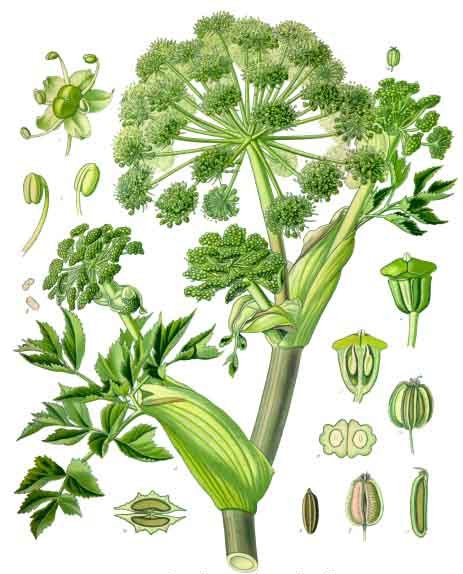
ⓒ
Photo: Franz Eugen Köhler, Köhler's Medizinal-Pflanzen · Public domain · Original file (Wikimedia Commons)
One of the secret ingredients behind gin's distinctive aroma. Its hollow green stems, candied in sugar, become emerald-colored sweets that once decorated European cakes. It belongs to the same group as the Korean medicinal herb danggwi.
Flavor and aroma
- It has a deep, musky herbal aroma and a bittersweet, warm taste.
- Its aroma is similar to juniper berries (the main ingredient in gin).
Fun facts
- It's one of the botanicals most used in making gin, and it gives gin a dry taste.
- It's also used in spirits such as Chartreuse, Bénédictine, vermouth and absinthe.
- Its nickname is "angel's herb."
- It's in the same genus, Angelica, as the plants used for the Korean medicinal herb danggwi.
- The Sámi people of northern Europe made traditional instruments from the stems.
In the kitchen
Raw
- Add young leaves and shoots to salads.
Drinks
- Dry the leaves for tea.
Desserts
- Candy the stems in sugar syrup to make candied angelica. Use it to decorate cakes and cookies or mix it into batter. Slice it into thin rings to decorate ice cream.
Fruit dishes
- Cook the stems with rhubarb and apple. Add them to jam and marmalade too.
Cooking
- Use the leaves to flavor fish (especially trout), chicken, soups, stews and omelets. Cook the stems like asparagus, or peel them and eat raw.
Goes well with
RhubarbAppleTroutEggsJuniper berries
Tips
- Candied angelica keeps for several months in an airtight container in a cool place.
Season
We're still checking the season. We'll add it once we find a source.
Details
- Korean name
- 안젤리카
- English names
- angelica, garden angelica, Norwegian angelica
- Scientific name
- Angelica archangelica
- Family
- Apiaceae
- Genus
- Angelica
Show sources for this page
References for this herb
- Wikipedia
- Plants of the World Online
- Gin Guild
- Dunnet Bay Distillers
- Hunter Angler Gardener Cook
- Mother Earth News
- Cooksinfo
Name and classification
Photo
Franz Eugen Köhler, Köhler's Medizinal-Pflanzen · Public domain · Original file (Wikimedia Commons)